


Pi Network’s PI token has started the year on a subdued note, lagging behind the modest recovery seen across parts of the broader crypto market. While several large-cap assets have attempted relief rallies in early January, PI has remained largely range-bound near its recent lows, reflecting persistent selling pressure and cautious sentiment among holders.
For many Pioneers who anticipated stronger post-new-year momentum, the slow price response is becoming a point of visible frustration.
On the daily chart, PI/USDT continues to trade within a well-defined broader downtrend that has been in place for months. Since the year began, price action has hovered around the $0.18–$0.20 zone, with repeated failures to establish a sustained move above short-term resistance.
A recent sharp downside wick toward the mid-$0.15 area was quickly bought, but the rebound lacked follow-through — a sign that dip demand exists, yet conviction remains limited.
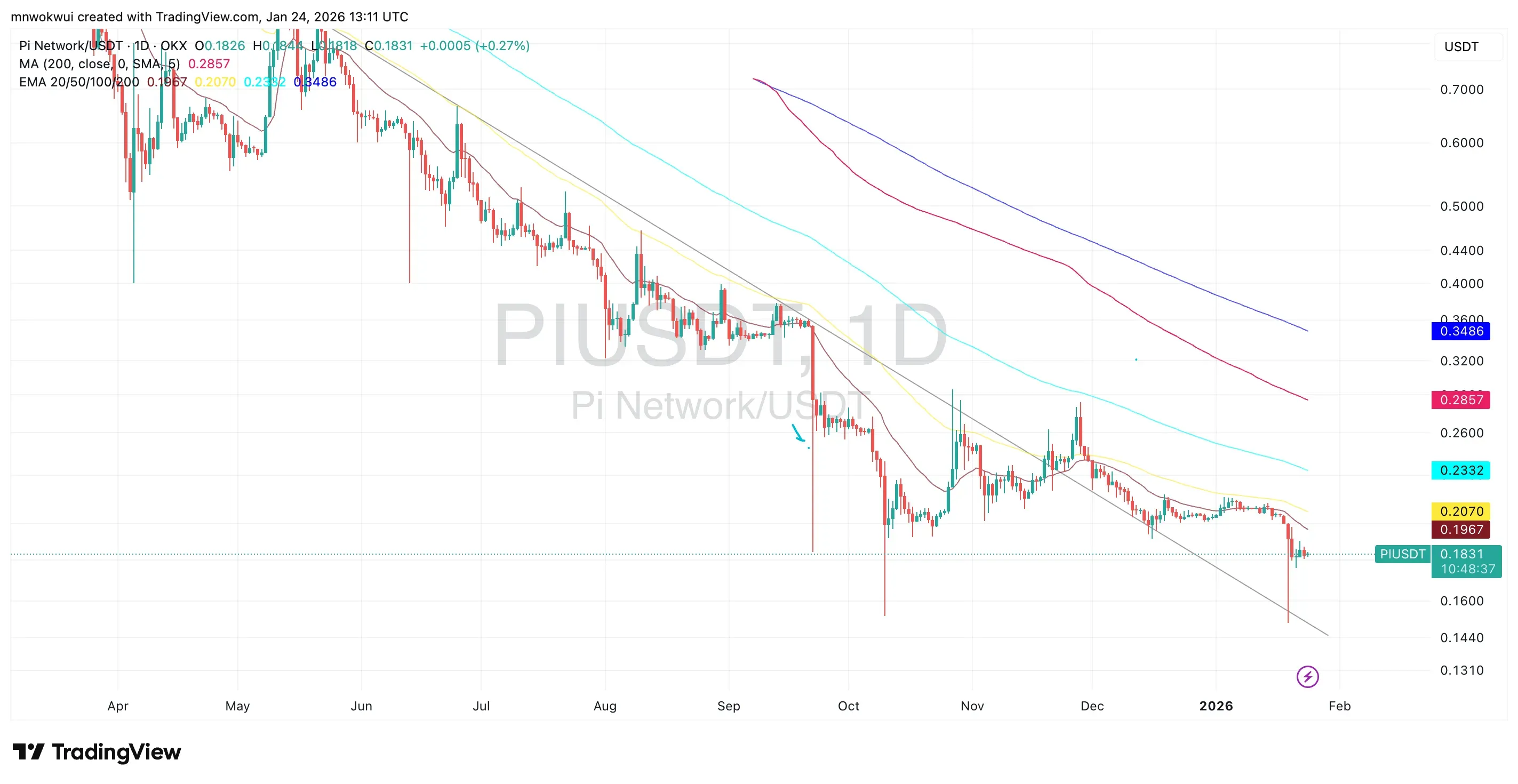
Technically, the structure still favors bears. Price is trading below all major moving averages, including the 20-day, 50-day, 100-day, and 200-day lines, which are stacked in bearish alignment and sloping downward. This configuration typically reflects a market where rallies are viewed as selling opportunities rather than trend reversals. Each attempt to push higher since early January has been capped near the declining short-term averages, reinforcing the idea of dynamic resistance overhead.
Volume behavior also suggests a lack of aggressive accumulation. While there have been occasional spikes on volatile sessions, sustained expansion in bullish volume — usually needed to signal a durable bottom — has yet to appear.
Bearish Scenario
If PI fails to reclaim the $0.20–$0.21 region convincingly, the risk of further downside remains elevated. That area now acts as immediate resistance, aligning closely with short-term moving averages and prior consolidation breakdown levels. Continued rejection there could open the door for another test of recent lows around $0.16, with a deeper slide toward the $0.14–$0.15 zone possible if broader market sentiment weakens.
A daily close below the recent wick lows would be technically significant, as it would confirm that buyers are no longer defending that area effectively. In such a case, the longer-term downtrend structure would remain intact, and sentiment among retail holders could deteriorate further.
Bullish Scenario
For bulls, the first step is stability — holding above the mid-$0.16 to $0.17 support area and gradually building higher lows. A decisive break and daily close above $0.21 would be the first meaningful sign that short-term momentum is shifting. That could trigger a move toward the $0.23–$0.25 range, where stronger resistance from previous consolidation and the declining 100-day average comes into play.
A broader trend reversal, however, would require PI to reclaim levels above the $0.28–$0.30 zone and flatten the longer-term moving averages — something that currently appears distant but not impossible if market-wide risk appetite improves.
Until buyers demonstrate stronger commitment, the token’s early-year performance suggests consolidation at best and continued downside risk at worst, leaving Pioneers watching closely for a clearer shift in momentum.